
 Rob Jones, Tamaqua Public Works Director, released the 2014 Tamaqua Area Water Authority Consumer Confidence Report (CCR), also known as Drinking Water Quality Report. (Public Water System ID: 3540012)
(Click HERE to view the report or view it below.)
It reads:
Water Authority:
We are pleased to present to you this year’s Annual Drinking Water Quality Report. This report is designed to inform you about the quality water and services we deliver to you every day. Our constant goal is to provide you with a safe and dependable supply of drinking water. We want you to understand the efforts we make to continually improve the water treatment process and protect our water resources. We are committed to ensuring the quality of your water.
If you have any questions about this report or the water system, please contact Robert Jones, Tamaqua Public Works Director, at (570) 668-0300. We want our valued customers to be informed about their water utility. If you want to learn more, please attend any of our regularly scheduled meetings. They are held on the third Monday of each month at 7:30 p.m. at the Authority office at 320 East Broad Street, Tamaqua,
Pennsylvania.
Water Supply System:
Our water source is surface water from Still Creek Reservoir, located in Rush Township; which has a total storage capacity of 2,700 million gallons. Raw water from the reservoir is treated at the Still Creek Filtration Plant before being distributed to water system customers. In 2014, the Tamaqua water system served about 1.850 million gallons per day to 3,557 customers, of which 3,076 were residential customers. Water service was also provided to 387 commercial, 22 industrial, and 72 institutional/public customers.
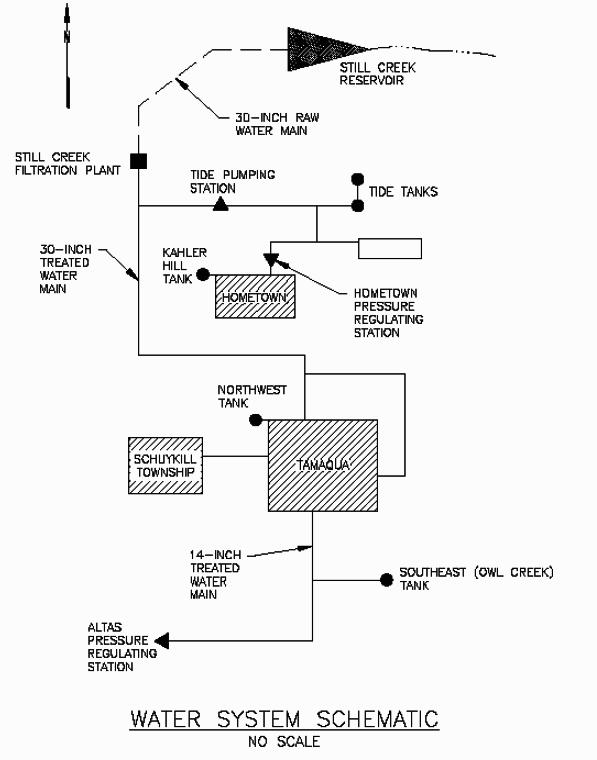
Locations of the Tamaqua water system source of supply, filtration plant, major transmission mains, pumping stations, pressure regulating stations, storage tanks, and general service area are shown on the accompanying schematic diagram.
In order to ensure that your tap water is safe to drink, the U.S. Environmental Protection Agency (EPA) prescribes regulations that limit the amount of certain contaminants in water provided by public water supply systems. We are happy to report that your drinking water meets Federal and State water quality requirements.
Contamination Potential:
As water travels over the surface of the land or through the ground, it dissolves naturally occurring minerals and, in some cases, radioactive material, and can pick up substances resulting from the presence of animals and from human activity.
Contaminants that may be present in the raw (source) water before treatment include:
• Microbial contaminants, such as viruses and bacteria, which may come from sewage treatment plants, septic systems, agricultural livestock operations, and wildlife.
• Inorganic contaminants, such as salts and metals, which can be naturally occurring or result from urban stormwater runoff, industrial or domestic wastewater discharges, oil and gas production, mining, or farming.
• Pesticides and herbicides, which may come from a variety of sources, such as agriculture, urban stormwater runoff, and residential uses.
• Organic chemical contaminants, including synthetic and volatile organic chemicals, which are by-products of industrial processes and petroleum production, and can also come from gas stations, urban stormwater runoff, and septic systems.
• Radioactive contaminants, which can be naturally occurring or the result of oil or gas production and mining activities.
All sources of drinking water are subject to potential contamination by constituents that are naturally occurring or manmade. Drinking water, including bottled water, may reasonably be expected to contain at least small amounts of some contaminants. The presence of contaminants does not necessarily indicate that the water poses a health risk. More information about contaminants and potential health effects associated with them can be obtained by calling EPA’s Safe Drinking Water Hotline (800-426-4791) or by visiting the EPA Office of Drinking Water website at http://water.epa.gov/drink.
Vulnerability:
Some people may be more vulnerable to contaminants in drinking water than the general population. Immuno-compromised persons, such as persons with cancer undergoing chemotherapy, persons who have undergone organ transplants, people with HIV/AIDS or other immune system disorders, some elderly, and infants can be particularly at risk from infections. These people should seek advice about drinking water from their health care providers. EPA/CDC guidelines on appropriate means to lessen the risk of infection by Cryptosporidium and other microbiological contaminants are available from the EPA Safe Drinking Water Hotline (800-426-4791).
Monitoring:
The Tamaqua Area Water Authority routinely monitors for constituents in your drinking water according to Federal and State laws.
The following table shows our monitoring results for the period January 1 to December 31, 2014. This table shows only the contaminants that were detected and the level at which they were detected. There are many other contaminants that we tested for in 2014 and previous years that were not detected. The Authority is not required to monitor for some contaminants every year because the concentrations of these contaminants do not change frequently. The data shown in the following table are for the most recently collected sample for each contaminant. For example, samples for lead and copper were last collected in 2013. All other data shown in the table are from samples collected in 2014. Remember that the presence of certain contaminants does not necessarily pose a health risk.
Definitions:
Throughout this report you will find some terms and abbreviations that you might not be familiar with. To help you better understand these terms, we’ve provided the following definitions:
• Action Level (AL) – The action level is the concentration of a contaminant which, if exceeded, triggers treatment or other requirements that a water system must follow.
• Locational Running Annual Average (LRAA) – Running annual average at a specific sample site.
• Maximum Contaminant Level (MCL) – The highest level of a contaminant that is allowed in drinking water. MCLs are set as close to the MCLGs as feasible using the best available treatment technology.
• Maximum Contaminant Level Goal (MCLG) – The level of a contaminant in drinking water below which there is no known or expected risk to health. MCLGs allow for a margin of safety.
• Maximum Residual Disinfectant Level (MRDL) – The highest level of a disinfectant allowed in drinking water. There is convincing evidence that addition of a disinfectant is necessary for control of microbial contaminants.
• Maximum Residual Disinfectant Level Goal (MRDLG) -The level of a drinking water disinfectant below which there is no known or expected risk to health. The MRDLG does not reflect the benefits of the use of disinfectants to control microbial contaminants.
• Minimum Residual Disinfectant Level (MinRDL) – The minimum level of residual disinfectant required at the entry point to the distribution system.
• Nephelometric Turbidity Unit (NTU) – A measure of the clarity of water. Turbidity in excess of 5 NTU is just noticeable to the average person.
• Not applicable (n/a) – Does not apply.
• Parts per billion (ppb) or Micrograms per liter (ug/l) – One part per billion corresponds to 1 minute in 2,000 years or a penny in $10,000,000. As a comparison, 1,000 ppb = 1 ppm.
• Parts per million (ppm) or Milligrams per liter (mg/l) – One part per million corresponds to 1 minute in 2 years or a penny in $10,000. As a comparison, 1 ppm = 1,000 ppb.
• pCi/L – picocuries per liter (a measure of radioactivity).
• Treatment Technique (TT) – A treatment technique is a required process intended to reduce the level of a contaminant in drinking water.
• < – Less than the value indicated.

Source Water Protection
In 2003, a Source Water Assessment was completed for the Authority that identified and evaluated potential contamination threats to the Authority’s raw water source. The assessment found that our source water is potentially most susceptible to agricultural runoff. Overall, our source water has little risk of significant contamination. A copy of the report is available for review at the Authority office.
The Authority is in the process of implementing a source water protection program for the Still Creek Reservoir.
Notice of Violations
In 2014, our water system received a violation from PADEP because the 2013 CCR was not received by PADEP on time. The CCR was delivered to our customers on time and was approved as complete by PADEP after it was submitted.
There were also two violations related to the miscommunication of turbidity sample data to PADEP. All required samples were collected on time and all sample results were within regulatory limits.
The violations received were paperwork errors and were not a result of any water quality problems. As indicated in the previous table, the results of all water quality samples collected in 2014 met safe drinking water standards.
Lead in Drinking Water
If present, elevated levels of lead can cause serious health problems, especially for pregnant women and young children. Lead in drinking water is primarily from materials and components associated with service lines and home plumbing. The Tamaqua Area Water Authority is responsible for providing high quality drinking water, but cannot control the variety of materials used in plumbing components. When your water has been sitting for several hours, you can minimize the potential for lead exposure by flushing your tap for 30 seconds to 2 minutes before using water for drinking or cooking. If you are concerned about lead in your water, you may wish to have your water tested. Information on lead in drinking water, testing methods, and steps you can take to minimize exposure is available from the EPA Safe Drinking Water Hotline (800-426-4791) or the EPA website at http://www.epa.gov/lead.
Customer Notification System
The Authority maintains an automatic telephone dialing system to comply with the PADEP Public Notification Rule. The system will be used to quickly notify our customers of water system-related issues, as required by PADEP. In order to maintain a current and accurate database, we ask all customers to notify the Authority, by calling (570) 668-0300, if you change your address and/or telephone number.
Summary
As you can see by the Test Results table, the Authority’s water system had no water quality violations in 2014. We’re proud that your drinking water not only meets, but is better than all Federal and State water quality requirements. Through our monitoring and testing programs, some constituents have been detected; however, the EPA has determined that your water is safe at these levels for the general population.
Landlords, apartment managers, businesses, schools, and others are encouraged to share this 2014 Annual Drinking Water Quality Report with all water consumers at their respective locations. We thank you for your cooperation in distributing this important information.
The Tamaqua Area Water Authority works around the clock to provide top quality water to every tap. We ask that all our customers help us protect our water source, which is the heart of our community, our way of life, and our children’s future.
 TamaquaArea.com
What about thr csncer cluster from tamaqua to mcadoo? Any clear teason why this is occurring? 1 out of every 1, 000, 000 are unfortunste to get this rsre blood disease. Are there answeres. Thid is the 21sr century the snswers are there why not release the problem and inform the public?
If there are no answers getca competent research grouo to find the problem. .
Regards
Teachjava@gmail.com
LikeLike