

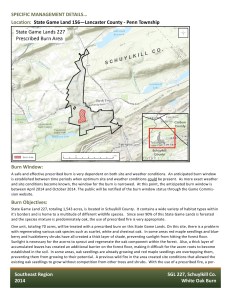
Residents in and around Rush Township might see smoke in the sky today (Friday, April 18, 2014) as crews with the Pennsylvania Game Commission (PGC) perform a controlled burn of a 70-acre section of state game lands southwest of Hometown. The best way to explain the location of the burn would be “the area between the Hometown Farmers Market and the Tuscarora Lake State Park.”
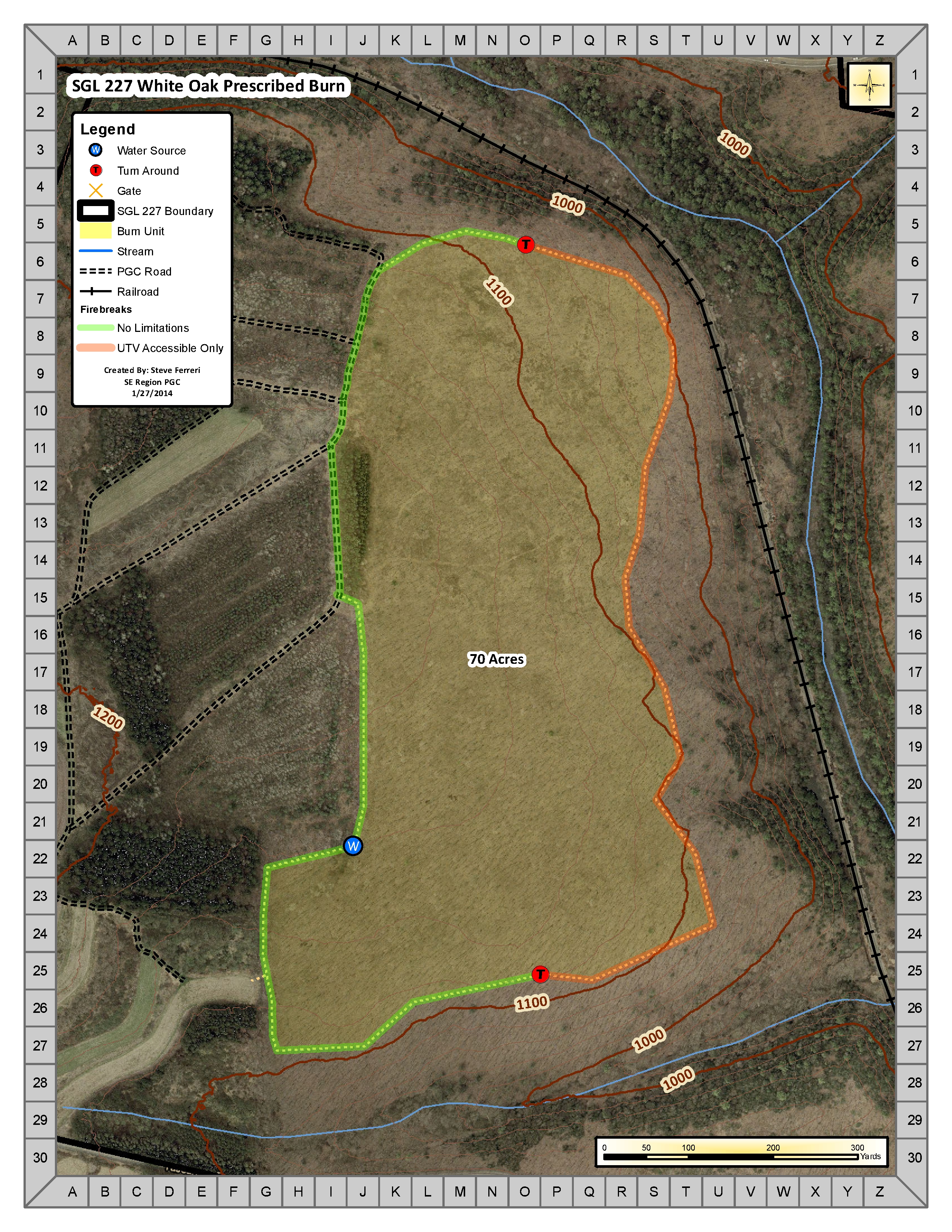
Barry Messerschmidt, Chief, Hometown Fire Company, announced during Thursday night’s township meeting that the PGC said they expect to start the controlled burn sometime Friday. This size of the burn is about 1/4 mile by 1/2 mile in size.
–
–
Below information from online correspondence for the PGC burn titled: SGL 227 White Oak Burn.
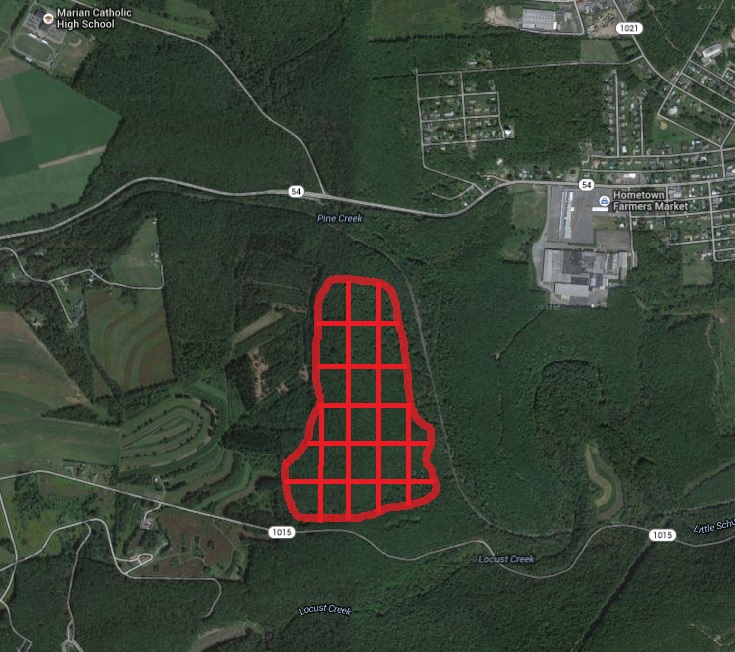
Approximate illustration of burn area via TamaquaArea.com.
Improving Forest Habitat With Prescribed Fire
The Pennsylvania Game Commission is using prescribed fire to improve forest habitat on State Game Lands throughout the Southeast Region.
———-
THE PROBLEM…
The majority of State Game Lands are forested, with oak species being a major component. As an oak forest begins to age, the new oak seedlings are out-competed by other tree species (such as birch, maple and tulip poplar). The overall impact to the forest is a decline in the number of oak seedlings growing into mature trees and a change in the species composition of the forest.
This decline in the number of oak seedlings is a problem because oak trees are extremely valuable to wildlife. Oak acorns have high nutritional value and are sought after as a fall food by a variety of birds and mammals as they prepare for the winter. While other trees may hold some value to wildlife, they don’t compare to the benefits derived from oak.
Oak trees are very different from birch, maple and tulip poplar. Their bark is much thicker and their root systems are much deeper. Because of these fundamental differences, fire can be used to promote the growth of oak seedlings and reduce competition from other species. A very controlled, slow moving “prescribed fire” can be used to remove the black birch, red maple and tulip poplar seedlings from the forest understory. The fire will enable the oak seedlings, already present on the site, to sprout and grow without interference from surrounding vegetation. This will allow oak to remain the dominant species as this forest grows.
———-
HOW DID WE GET HERE…
Throughout Pennsylvania’s long history, oak trees have evolved with low intensity fires, a lot of them occurring naturally. Fires were intentionally set by native Americans for thousands of years to promote wild berries and improve game habitat. In the early part of the 20th century, public concern over wild fires led to the creation of the US Forest Service’s Smokey Bear campaign in 1944. Since then, wildfires have been all but eliminated from the state. This has not had a completely positive result. Because of the reduction of fires, Pennsylvania forests have changed and resulted in the gradual transition away from a forest that was once dominated by oak trees to a forest now dominated by red maple and black birch. In order to increase the number of oak trees on each site, the Game Commission attempts to mimic those earlier growing conditions by reintroducing fire, in a controlled manner, back into the forest ecosystem.
The Game Commission has been using prescribed fire as a habitat management tool for more than ten years, burning
thousands of acres, from grasslands to forests.
Prescribed fires may be scheduled to occur from mid-March to early November depending on the weather and site
conditions. All prescribed fires will be conducted and guided by all laws, standards and procedures of the Prescribed Burn
Practices Act, as well as techniques learned from prescribed fires on other State Game Lands.
———-
WHAT TO EXPECT…
The use of prescribed fire, sometimes referred to as a controlled burn, is very different from a “wild fire.” With a prescribed fire, safety is the first consideration in the process, from the planning through the implementation.
The entire operation is overseen by a “Burn Boss.” The process for a prescribed fire begins with a detailed plan written by the Burn Boss, approved by the Pennsylvania Game Commission and reviewed by other state agencies.
Only after this has been accomplished, can the agency move forward with the prescribed fire.
The timing of a burn is very weather dependent and takes into account the amount of moisture both in the ground and in the growing vegetation. The public will be able to find information on the exact burn window for all prescribed fires in the Southeast Region on the Game Commission website.
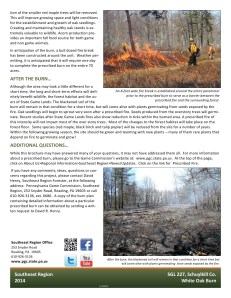
In anticipation of the burn, an eight foot wide fire break is established around the entire area. Prior to the burn, all of the leaves and branches are removed from the fire break so that it will serve as a barrier between the prescribed fire and the surrounding forest.
During the day of the prescribed fire, access to the site will be restricted and only people directly associated with the burn will be allowed access at or near the site. Trained staff will be on hand with numerous pieces of fire equipment and water resources. All necessary local fire and emergency personnel will be notified in advance.
Prior to the start of the prescribed burn, a small, easily extinguished “test” burn will be conducted so that the Burn Boss can check the fire behavior and smoke dispersion patterns for the day. If the “test” fire burns within the predetermined parameters, the prescribed fire will be allowed to continue. If it does not burn within those parameters, it will be called off for the day.
If the Burn Boss approves the prescribed fire to proceed, an experienced crew of Game Commission and other natural resource agency personnel will use a regimented process to burn the site.
As the fire begins to burn out, remaining areas with flames will be extinguished. After the prescribed burn is finished, there may still be small amounts of smoke present within the interior of the prescribed fire area as some of the vegetative material burn out. Flames will not be present though and there will be no danger to surrounding forest. The area will be monitored over the next 24 hours.
Crews review final safety and management plans with the Burn Boss prior to the beginning of the prescribed burn.
(Prior to the start of the prescribed fire, a small test fire is conducted so that the Burn Boss can check fire behavior. If the test fire does not burn within predetermined parameters, it will be called off for the day.)
———-
BURN WINDOW…
A safe and effective prescribed burn is very dependent on both site and weather conditions. An anticipated burn window is established between time periods when optimum site and weather conditions could be present. As more exact weather and site conditions become known, the window for the burn is narrowed. At this point, the anticipated burn window is between April 2014 and October 2014. The public will be notified of the burn window status through the Game Commission website.
———-
BURN OBJECTIVES…
State Game Land 227, totaling 1,543 acres, is located in Schuylkill County. It contains a wide variety of habitat types within it’s borders and is home to a multitude of different wildlife species. Since over 90% of this State Game Lands is forested and the species mixture is predominately oak, the use of prescribed fire is very appropriate.
One unit, totaling 70 acres, will be treated with a prescribed burn on this State Game Lands. On this site, there is a problem with regenerating various oak species such as scarlet, white and chestnut oak. In some areas red maple seedlings and blue-berry and huckleberry shrubs have all created a thick layer of shade, preventing sunlight from hitting the forest floor. Sunlight is necessary for the acorns to sprout and regenerate the oak component within the forest. Also, a thick layer of accumulated leaves has created an additional barrier on the forest floor, making it difficult for the acorn roots to become established in the soil. In some areas, oak seedlings are already growing and red maple seedlings are overtopping them, preventing them from growing to their potential. A previous wild fire in the area created site conditions that allowed the existing oak seedlings to grow without competition from other trees and shrubs. With the use of a prescribed fire, a portion of the smaller red maple trees will be removed. This will improve growing space and light conditions for the establishment and growth of oak seedlings. Creating and maintaining healthy oak stands is ex-tremely valuable to wildlife. Acorn production pro-vides an important fall food source for both game and non game animals.
In anticipation of the burn, a bull dozed fire break has been constructed around the unit. Weather permitting, it is anticipated that it will require one day to complete the prescribed burn on the entire 70 acres.
(An 8-foot wide fire break is established around the entire parameter prior to the prescribed burn to serve as a barrier between the prescribed fire and the surrounding forest.)
———-
AFTER THE BURN…
Although the area may look a little different for a short time, the long and short-term effects will definitely benefit wildlife, the forest habitat and the us-ers of State Game Lands. The blackened soil of the burn will remain in that condition for a short time, but will come alive with plants germinating from seeds exposed by the fire. Oak seedlings will begin to sprout very soon after a prescribed fire. Seeds produced from the overstory trees will germinate. Recent studies after State Game Lands fires also show reduction in ticks within the burned area. A prescribed fire of this intensity will not impact most of the over story trees. Most of the changes to the forest habitat will take place on the forest floor. Some species (red maple, black birch and tulip poplar) will be reduced from the site for a number of years. Within the following growing season, the site should be green and teeming with new plants – many of them rare plants that depend on fire to germinate and grow!
(After the burn, the blackened soil will remain in that condition for a short time but will come alive with plants germinating from seeds exposed by the fire.)
———-
ADDITIONAL QUESTIONS…
While above information may have answered many of your questions, it may not have addressed them all. For more information about a prescribed burn, please go to the Game Commission’s website at: www.pgc.state.pa.us. At the top of the page, click on About Us>Regional Information>Southeast Region>News/Updates. Click on the link for Prescribed Fire.
If you have any comments, ideas, questions or concerns regarding this project, please contact David Henry, Southeast Region Forester, at the following address: Pennsylvania Game Commission, Southeast Region, 253 Snyder Road, Reading, PA 19605 or call (610) 926-3136, ext. 6686. A copy of the burn plan containing detailed information about a particular prescribed burn can be obtained by sending a written request to Henry.
Here is the link to the burn window status form online: http://www.portal.state.pa.us/portal/server.pt/document/1405932/2014_burn_window_status_pdf.
 TamaquaArea.com